Isotopic Tracing of [13C6]scyllo-Inositol Uncovers Its Incorporation into Phosphatidylinositols in Immortalized Mammalian Cells
M.M. Amma; L. Kollipara; T. Dürr-Mayer; J. Streeck; P. Schmieder; A. Saiardi; H.J. Jessen; S. Heiles; D. Fiedler
ACS Chem. Biol. 21, 2232-2243 (2026)
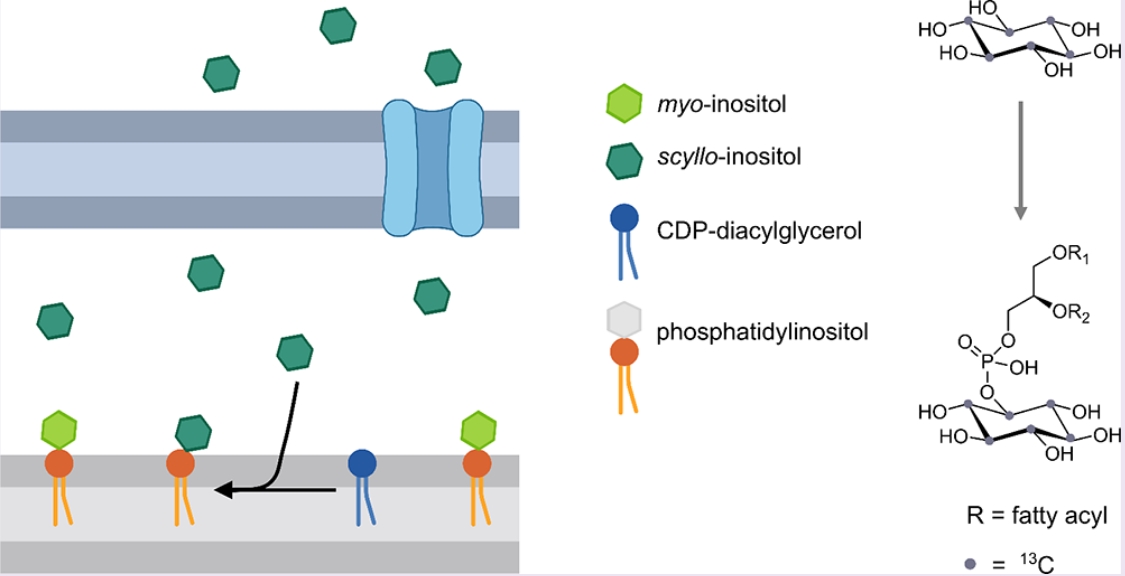
Inositols are a family of cyclic sugar alcohols comprising nine stereoisomers. myo-Inositol is the most abundant isomer found in humans and has been studied most extensively. It plays an important role in osmoregulation and is incorporated into membrane-anchored phosphatidylinositols. scyllo-Inositol is the second most abundant inositol isomer in the human brain, and aberrant concentrations are associated with various diseases; however, its biological functions remain unclear. Here, the development and application of [13C6]scyllo-inositol as an isotopic tracer to study its metabolism are reported. A concise and robust synthetic route was established to obtain [13C6]scyllo-inositol from [13C6]myo-inositol in good yield. The uptake of [13C6]scyllo-inositol at concentrations used in clinical trials and the responses of endogenous inositol isomers were measured in multiple immortalized mammalian cell lines by hydrophilic liquid interaction (HILIC)-MS/MS. [13C6]scyllo-Inositol proved to be a versatile isotopic tracer when coupled with mass spectrometry (MS)-based lipidomics and 2D nuclear magnetic resonance (NMR) experiments. These experiments provide evidence that scyllo-inositol is incorporated into phosphatidylinositols in different immortalized mammalian cell lines and suggest a previously underappreciated role of scyllo-inositol. Future research utilizing [13C6]scyllo-inositol can elucidate scyllo-inositol metabolism and its role in physiological and diseased states.
